
Architecture Drift in Android & KMP Monorepos: How Big Codebases Rot and How to Stop It
A 50-module Android or Kotlin Multiplatform repository rarely becomes unmaintainable because of a flawed high-level diagram. It rots because dozens of pragmatic local shortcuts quietly break build isolation, destroy parallel compilation, and turn boundaries into suggestions.
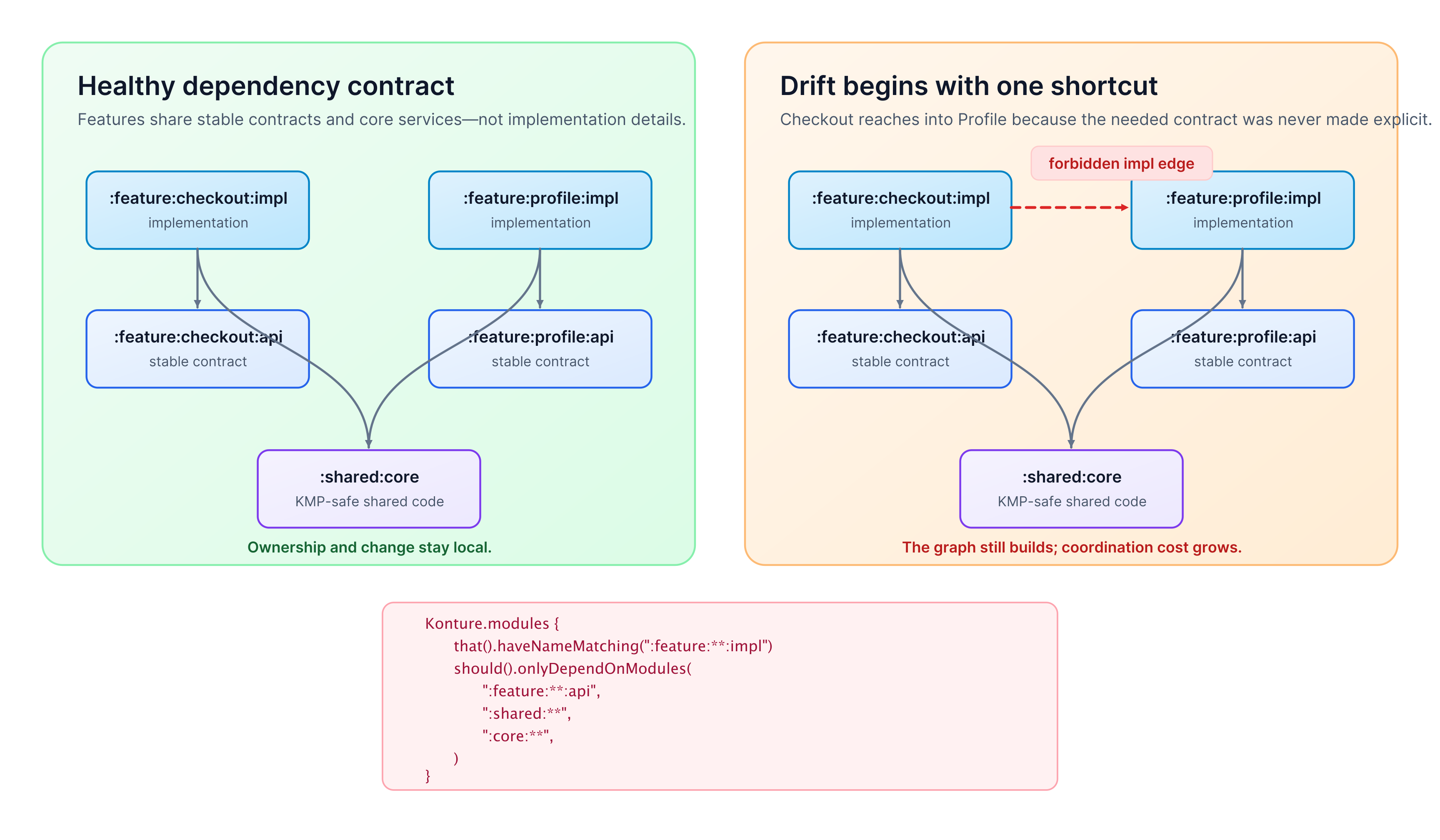
When a checkout team needs a customer’s delivery preferences, the fastest path to green is tempting:
// feature/checkout/impl/build.gradle.kts
dependencies {
    implementation(project(":feature:profile:impl"))
}
This single line compiles instantly, but it rewires the physics of your monorepo. Checkout no longer consumes what Profile offers; it is bound to how Profile is built.
When Profile tweaks an internal layout or helper, Checkout is forced to recompile, re-DEX, and re-test. Remote build cache hits plummet, CI pipelines bottleneck, and PR approvals require cross-team coordination. That is architecture drift: the gap between intended boundaries and the physical graph the repository permits.
The 4 Hard Technical Penalties of Architecture Drift
Drift is not a stylistic flaw—it is an economic and build-system tax driven by four concrete mechanics:
1. Gradle ABI Shielding Breakdown & Cache Invalidation
Gradle uses ABI (Application Binary Interface) shielding to optimize incremental builds. When :checkout:impl depends on :profile:api, changes to private logic inside :profile:impl do not alter :profile:api’s ABI fingerprint. Gradle skips recompiling Checkout entirely.
With API Shielding (Fast Incremental Build):

[ :profile:impl Edit ]
         │
         ▼
Recompiles :profile:impl
         │
         ✕ (ABI Unchanged)
         ▼
  [ :profile:api ]
         │
         ▼
  SKIP :checkout:impl
Directly importing :profile:impl breaks this shielding. Any internal edit in Profile alters :profile:impl’s bytecode fingerprint, forcing downstream recompilation and re-DEXing:
Direct Implementation Coupling (Broken Shielding):

[ :profile:impl Edit ]
         │
         ▼
Recompiles :profile:impl
         │
         ▼ (Direct Dependency)
FORCED Recompilation & re-DEXing of :checkout:impl!
Cache Invalidation Impact: In a 100-module monorepo with 40 developers, dropping remote cache efficiency from 85% to 25% due to sideways
:implcoupling adds 3–6 minutes per incremental build—wasting 30 to 60 engineering hours daily.
2. DAG Parallelism Destruction & Critical Path Bottlenecks
16-core CI runners compile independent modules concurrently across worker threads. A clean :api/:impl structure creates a wide, shallow DAG (Directed Acyclic Graph) for maximum CPU utilization.
Parallel DAG (Fast — High Multi-Core CPU Utilization):

                  ┌──> :feature:checkout:impl (Worker 1)
:feature:*:api ───┼──> :feature:profile:impl  (Worker 2)
                  └──> :feature:search:impl   (Worker 3)
Sideways :impl dependencies serialize the graph into a deep execution chain where workers sit idle:
Serialized Execution Chain (Slow — Workers 2–16 Idle):

:feature:profile:impl
         │
         ▼
:feature:checkout:impl
         │
         ▼
:feature:cart:impl
         │
         ▼
:app
This serialization forces multi-core runners onto a single execution thread, inflating CI pipeline queues from 2 to 15 minutes.
3. Testing Isolation Collapse
Testing :checkout:impl against a clean :profile:api interface requires a lightweight JVM fake:
// Fast, isolated JVM test setup (~2ms execution)
val fakeProfileReader = FakeDeliveryPreferenceReader()
val viewModel = CheckoutViewModel(deliveryPreferenceReader = fakeProfileReader)
Coupling Checkout to :profile:impl forces unit tests to instantiate Profile’s Room/SQLDelight database, network engine, and DI graph. Test initialization time jumps from 2ms to 500ms+, turning unit tests brittle whenever Profile refactors an internal constructor.
4. Binary Bloat & KMP Target Graph Asymmetry
Direct implementation ties leak heavy transitive libraries (biometrics, camera SDKs, PDF renderers) into consuming features, swelling APK/IPA sizes and breaking Android Dynamic Feature Module (DFM) split contracts.
In Kotlin Multiplatform, target-specific source sets compound drift when dependencies compile on one target but bypass clean APIs:
// :feature:checkout:shared/build.gradle.kts
kotlin {
    sourceSets {
        androidMain.dependencies {
            // Leaks profile implementation ONLY into the Android target graph!
            implementation(project(":feature:profile:impl"))
        }
    }
}
The iOS build (iosMain) still compiles via an API module, but the product now runs two completely different dependency graphs. Android Checkout carries Profile’s internal dependencies and crash surface while iOS remains lean, making cross-platform bug investigation exceptionally difficult.
Anatomy of a Leak: The Checkout-to-Profile Failure
In a modular monorepo (:app, :feature:checkout:api, :feature:checkout:impl, :feature:profile:api, :feature:profile:impl), Checkout needs delivery preferences. Instead of requesting an API extension, Checkout imports Profile’s internal repository:
// :feature:checkout:impl
import io.github.acme.profile.internal.data.DeliveryPreferencesRepository // 🚨 Illegal Leak!

class CheckoutViewModel(
    private val deliveryPreferencesRepository: DeliveryPreferencesRepository,
) : ViewModel()
The 3 Architectural Repairs
| Repair Path | Action | Best Used When |
|---|---|---|
| 1. Expose Stable API | Add DeliveryPreferenceReader interface to :feature:profile:api. | Capabilities are owned by a specific feature. |
| 2. Promote to Core Domain | Extract contract to a shared domain module (e.g., :shared:domain:delivery). | Capability is a core domain concept shared by many features. |
| 3. Bounded Exception | Record a dated, owned exception in the build graph with a removal ticket. | Short-term release trade-off requiring explicit tracking. |
Executable Architecture Guardrails with Konture
Konture enforces architectural rules as standard Kotlin unit tests, intercepting structural drift directly in CI.
1. Guard Targeted Boundaries
Block specific illegal edges that cause immediate team friction:
@Test
fun `checkout implementation must not depend on profile implementation`() {
    Konture.modules {
        that().haveNamePath(":feature:checkout:impl")
        should().mustNotDependOn(":feature:profile:impl")
    }
}
2. Enforce Category Allow-Lists
Shift PR discussions from “Can we take this shortcut?” to “Which approved API contract should we use?”:
@Test
fun `feature implementations must only depend on approved APIs and core`() {
    Konture.modules {
        that().haveNameMatching(":feature:**:impl")
        should().onlyDependOn(
            ":feature:**:api",
            ":shared:**",
            ":core:**",
        )
    }
}
3. Protect Package Slices Within Modules
Prevent sideways package coupling inside shared or multi-feature modules:
@Test
fun `feature package slices must remain strictly isolated`() {
    Konture.slices {
        matching("com.acme.feature.(*)..")
            .should().notDependOnEachOther()
    }
}
(*) extracts each feature package name as a slice key, flagging cross-feature imports even if both packages reside in the same Gradle project.
4. Ban Circular Dependencies
Act as an automated circuit breaker to prevent circular module chains:
@Test
fun `the module graph must remain completely acyclic`() {
    Konture.assertNoCycles()
}
Pragmatic Rollout & Leadership Metrics
To enforce architectural rules without freezing feature delivery, follow a 4-step progressive rollout:
Step 1: Map Graph & Identify High-Cost Edges
                   │
                   ▼
Step 2: Baseline Legacy Debt
                   │
                   ▼
Step 3: Block New PR Violations in CI
                   │
                   ▼
Step 4: Refactor via Explicit API Contracts
Key Engineering Leadership Metrics
| Metric | Target | What It Indicates |
|---|---|---|
| Remote Cache Hit Rate | >80% | Low values signal sideways :impl leaks triggering cache invalidation. |
| DAG Critical Path Length | Shallow Depth | Increasing depth signals task serialization and CI worker starvation. |
| Cross-Team PR Approvals | 1 Team / PR | Multi-team PR requirements reveal domain coupling. |
| Exception Ticket Age | <30 Days | Prevents temporary architectural bypasses from becoming permanent debt. |
Conclusion
A whiteboard diagram has no operational value if engineers can bypass it in build.gradle.kts. By converting boundaries into automated Kotlin tests with Konture, you protect build cache efficiency, maintain parallel compilation, and ensure teams ship code independently at scale.